 Nozaninbegim Mamurjonova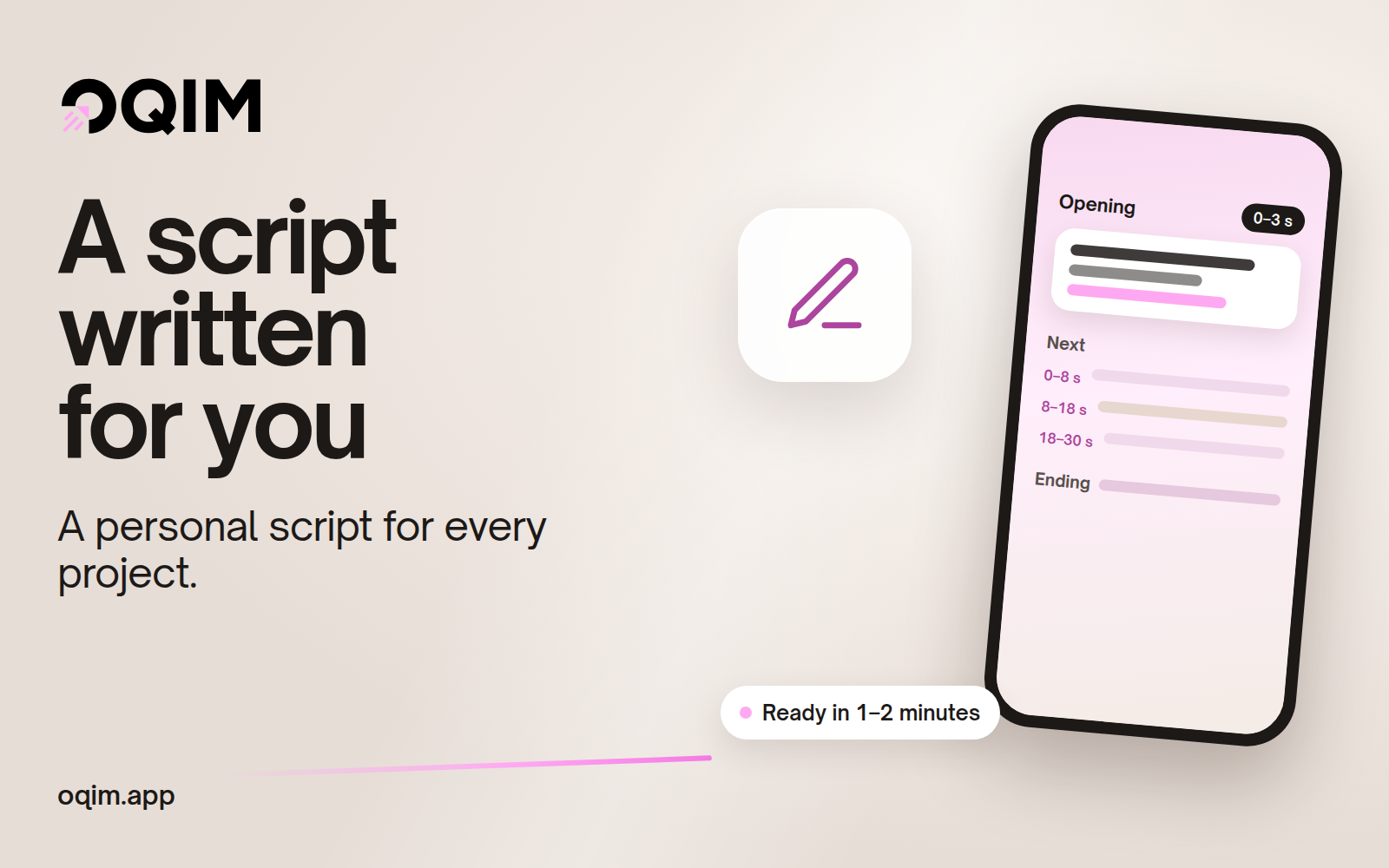
For most creators, the hardest part isn't filming.
You join a project, read the brief, pick up your phone — and stop. Where do you start? What should the first line be? When do you mention the product? Many people lose a day or two right here, and some never film at all.
Now, once you join a project on OQIM, a personal script is written for you. It's usually ready in a minute or two.
This isn't just the brief
The brief is the brand's requirement. It's the same for everyone: what the product is, which point has to come across, what to avoid.
The script is written for you alone. It combines the brand's brief with the direction you work in: your subject, your content language and the style of your videos. The result reads closer to one of your own videos than to someone else's text.
That's the difference: a template writes the same video for everybody, while this one is shaped around you.
What's in a script?
A script has four parts, and each one covers a stage of the video.
The opening — your first seconds. What to say, what text sits on screen, and what's in the frame. The number of seconds is written next to it.
Next — the body of the video, split into blocks. Each block says which second it runs from and to, what you say, and what you show. Every block also explains why it's there, which makes it easy to change to suit you.
The ending — your closing call. What you tell the viewer, and what stays on screen.
Filming notes — short, practical pointers: where to film, what to show, what to avoid.
The whole script copies with one button. Many creators send it to themselves on Telegram and glance at it while filming.
Why so much attention on the first seconds?
Because in short video, that's where everything is decided. A viewer takes three or four seconds to choose between watching and scrolling.
On top of that, by Instagram's own explanation, most of what people watch in Reels comes from accounts they don't follow. Your video can travel well beyond your own followers — but only if it holds a stranger from the first seconds.
That's why the opening is a separate part of the script, and gets the most attention.
Don't like it? Change it
The script isn't a rule. You can shape it.
There's a "Change" button. Write in your own words: make it funnier, speak more simply, I'm filming at home, show the product differently. The script is rewritten around your note. You can make up to ten such changes a day.
The "Another direction" button gives you a completely different approach — a problem-and-solution format instead of a personal story, for example, or the other way round. Nothing is lost: every version is kept in the history, and you can bring any of them back.
A change that contradicts the brand's requirements won't be applied. You can't remove a point the brand marked as required. In that case the script stays as it was, and you can phrase your request differently.
The brand never sees your script
This is worth saying plainly, because people ask often.
The script is yours alone. The brand doesn't see it, and nobody compares your video against it. The brand only sees the finished video, and judges it against the brief.
You're also free to ignore the script entirely. If your own idea is better, film that. The script is help, not homework.
It isn't on every project
Some projects don't need one. Tasks like "film inside the shop" or "show the unboxing" are clear without a written script, so the script card simply doesn't appear in those campaigns.
Scripts are written in Uzbek or Russian — whichever language the project and your audience use.
Sometimes a script fails to come through. That doesn't affect your work: the brief is still there and you can film on your own. You can also just try again.
How to use it well
Read the brief first. The script doesn't replace it, it builds on it. You should know exactly what the brand is asking for.
Don't recite the script. Read it through once or twice, then say it in your own words. A memorised script is obvious on camera, and it costs you the main strength of UGC: sounding natural.
Try keeping the opening as written. That part affects the result more than any other.
Fit it to your life. If the script calls for a street shot and you're at home, say so under "Change". A new version arrives in seconds.
If the first take feels stiff, film it again. Experienced creators shoot two or three takes too.
Why we built it
On OQIM you're paid for views, not for the video itself. The further your video travels, the more you earn. So a strong video isn't only the brand's interest, it's yours.
Until now that weight sat entirely on the creator: turn a brief into an idea, write an opening, build a structure. Part of that work now sits with the platform.
The script won't make the video for you. But instead of a blank page, you start with a structure.
Create your OQIM profile, join a project, and get your first script.