 Nozaninbegim Mamurjonova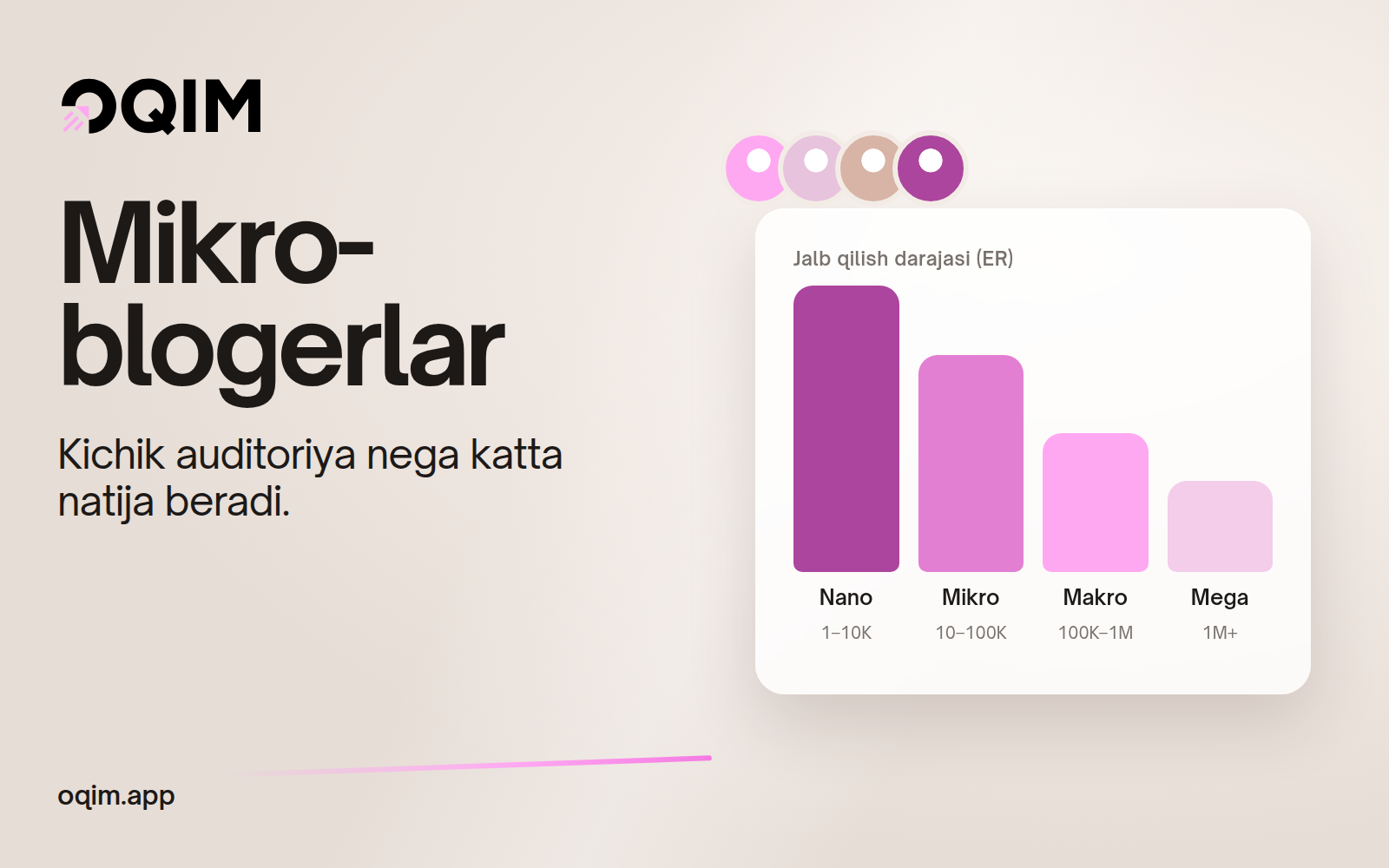
A small cosmetics brand is planning its advertising budget. There are two options. The first is to hand the whole budget to a famous blogger with a million followers for a single Story. The second is to split the same money among dozens of small creators.
Most choose the first. The logic is easy to follow: the more followers, the bigger the result should be. A famous name inspires confidence, and one deal means less work.
In practice the result often turns out differently.
Who is a micro-influencer?
Bloggers are usually classified by follower count. In the most widely used classification, accounts with 1,000 to 10,000 followers are nano-influencers and those with 10,000 to 100,000 are micro-influencers. From 100,000 to 1 million is macro, and above that is mega.
The boundaries vary a little by source. Some end the micro tier at 50,000; others carve out a separate “mid” tier from 100,000 to 500,000. But the essence is the same: a micro-influencer is a creator who works in a clear niche and stays close to their audience. In this article we refer to nano- and micro-influencers together as “micro-influencers”.
Why is a small audience more engaged?
As follower counts rise, audience engagement falls. Almost every study confirms this.
According to HypeAuditor’s 2025 report, 76% of Instagram influencers are nano-influencers, and engagement is highest precisely among them: 2.19% on 2024 data. Average engagement across Instagram as a whole is falling: from 1.85% in 2023 to 1.59% in 2024. The gap is even clearer in a 2021 study by Later and Fohr covering more than 3.5 million posts: engagement of around 4% for nano-influencers versus 1.3% for bloggers with 500,000 to 1 million followers.
The exact percentages depend on methodology, but the direction is the same. The reason is not hard to see. A creator with 5,000 followers answers comments personally, knows their followers’ questions and is known personally by many of them. A million-follower page has no such closeness. There the follower turns into a mere viewer.
Trust is the main capital
People trust people, not ads. In a 2021 Nielsen survey, 88% of respondents said they trust recommendations from people they know more than any other advertising channel.
A micro-influencer’s recommendation is received in exactly that spirit: not as an ad but as advice from someone you know. Their followers choose food with them, try cosmetics, read books and ask for parenting advice. So when they recommend a product, it sounds natural. A famous blogger’s ad, by contrast, is often filed under “advertising” before it even plays, and viewers respond accordingly.
A precise audience
Another strength of micro-influencers is that they usually work in a specific niche.
For a brand selling children’s products, an audience of 30,000 young mothers is worth more than a random million viewers. For a sports nutrition maker, a fitness coach’s 15,000 followers may bring more buyers than a famous actor’s 500,000.
In Uzbekistan there is one more factor: language and city. A Russian-speaking audience in Tashkent and an Uzbek-speaking audience in the regions do not respond to the same content in the same way. Among micro-influencers it is easy to pick creators in exactly the right language and region.
Ten small instead of one big
Back to the cosmetics brand from the start of the article.
Hand the whole budget to one big blogger and the result depends on a single video. If the video does not work, or goes out on the wrong day, the money goes with it. Split the same budget among ten micro-influencers and you get ten videos with different approaches. One shares a personal experience, another shows the product in use, a third does a funny scene. You see which worked best and build the next campaign around it.
This approach also reduces risk. The result comes from ten sources, not one. If one video underperforms, the others make up for it. On top of that, the brand ends up with ten finished videos instead of one, ready to reuse on its own page or in ads.
The world is turning this way
This is not just theory. According to Influencer Marketing Hub’s 2026 report, 52.8% of surveyed brands plan to expand or start working with micro-influencers, and 51.4% with nano-influencers. For macro-influencers the picture is different: those planning to expand and those planning to cut back are almost level, at roughly 20.6% each.
The picture in Uzbekistan is similar. As of early September, nearly 94% of approved creators on OQIM have fewer than 100,000 followers, and the median follower count is around 8,700. In other words, most of the content on the market is made precisely by small and medium creators. Whether a brand wants to work with them is not the question. The question is how to do it well.
How to pick a micro-influencer
Rule one: look at views, not follower count. How many views a creator’s last 10–15 Reels get says more than the follower number on the page. There is a big difference between an account with 20,000 followers whose every Reel gets 2,000 views and one with 8,000 followers that regularly gets 30,000.
Rule two: read the comments. A real audience asks questions, argues and shares its own experience. Nothing but emojis and identical “great!” comments is a warning sign.
Rule three: look at niche and style. Does the creator’s audience resemble your customers? Which language do they speak? Do their videos match your brand’s tone?
Where is the difficulty?
Working with micro-influencers is not easy, and there is no point hiding it.
Where one message is enough for a big blogger, ten small ones mean writing ten times, agreeing ten prices, checking ten videos and paying ten times. Every creator has their own price, timeline and way of working. Some accounts carry fake followers, and that is not always visible from outside.
That is why many brands want to work with micro-influencers but cannot get started. For a company whose marketing team is a handful of people, managing dozens of creators by hand is a job in itself.
Paying for views
OQIM gathers this process in one place. The brand creates a campaign, writes the brief and sets the budget and the price per 1,000 views. Creators join the campaign and make videos to the brief. The brand reviews and approves every video before it is posted. The views of the posted Reels are counted automatically.
Most important is the payment model. The budget is spent only on views that were actually collected. The brand pays the creator for the video’s real result, not for their follower count. Fake followers do not produce views, so no money goes to them. And throughout the campaign you can see which creator and which video are performing better.
Micro-influencers are not a fallback for small budgets. They are a strong channel in their own right. You just need to know how to work with them properly.
Create your first campaign on OQIM and pay only for real views.