 Nozaninbegim Mamurjonova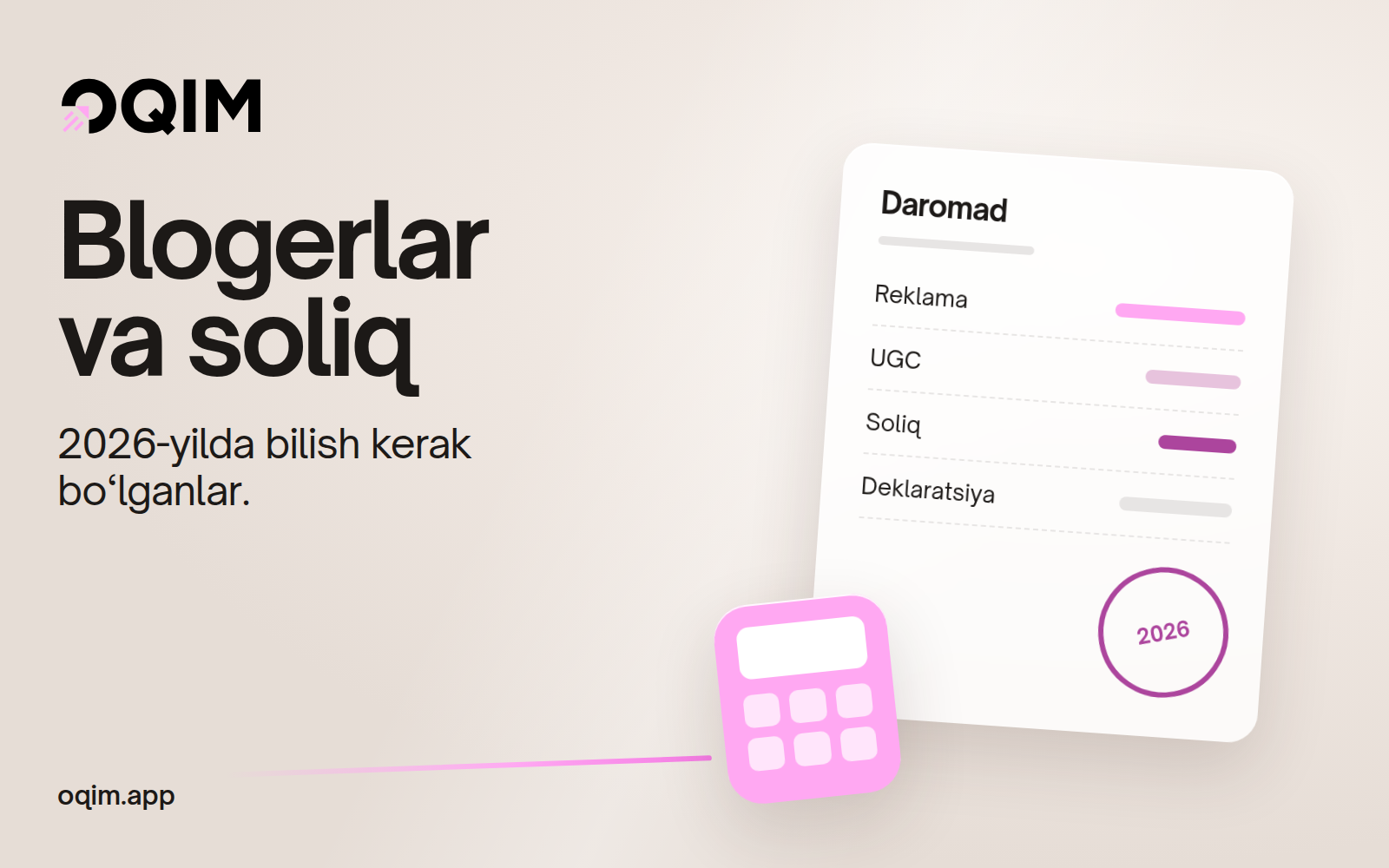
In 2026 the Tax Committee started paying serious attention to bloggers.
In February it emerged that the committee had studied Russia’s experience of bringing bloggers’ income under tax control. At the same time, blogger advertising was included in the 2025 GDP figures for the first time. The market was valued at UZS 760.2 billion, roughly $62 million.
In May the status of the 110 most active bloggers was examined. It turned out that 55 of them were registered as self-employed, 33 as individual entrepreneurs, and 22 worked with no status at all. The same month it was reported that six bloggers with more than three million followers had declared a combined income of UZS 2.7 billion for 2025 and paid UZS 110.4 million in tax.
In June the committee published its own estimate. Based on an analysis of ad posts and stories, those six bloggers’ advertising revenue could be around UZS 26 billion, with unpaid VAT of roughly UZS 3.1 billion. Bloggers were given three months to put their status in order.
Since then the question creators ask most is this: do bloggers pay taxes, and how much?
This article is for general information and is not a substitute for tax advice. The legislation changes quickly, so talk to an accountant before making a decision.
The short answer: yes
Blogging income is ordinary income. For now Uzbekistan has no separate “blogger tax” and no special licence for bloggers. The general rules apply. A Tax Committee representative said so plainly in June: blogging is entrepreneurial activity.
This does not apply only to big bloggers. Money from an ad post, a UGC video, an affiliate link or content made for businesses also counts as income. The only difference is scale.
How much you pay depends on which status you work under. For someone earning from content there are three options.
Self-employed
The simplest route for creators working alone. Registration through my.soliq.uz or the Soliq app takes a few minutes. No office or accountant is needed.
From 1 January 2026, self-employed people with annual turnover of up to UZS 1 billion pay tax of 1% of turnover. Previously income of up to UZS 100 million was tax-free; that exemption is gone. So if you earn UZS 10 million a month, the tax is UZS 100,000.
Social tax is voluntary under this status. But for the year to count towards your pension record, at least one base calculation unit (BCU) must be paid per year. From 1 September, 1 BCU is UZS 440,000.
There are two fine points. First, you cannot hire staff under this status. The Tax Committee drew attention to exactly this: many bloggers work with admins, editors and assistants. Second, from 2026 the list of activities permitted for the self-employed was cut from 104 to 72, and the word “blogger” is not on it. The closest entry is “Activity on social networks”, which covers advertising goods and services on social networks. Make sure your activity fits that entry before registering.
Individual entrepreneur
If you have an editor, an admin or a camera operator, an individual entrepreneur (IE) is the better choice.
Here too, with annual turnover of up to UZS 1 billion the tax is 1%. Above that you have to move to VAT and profit tax. The main difference is social tax: for an IE it is mandatory and at least 1 BCU per month. For a full year at a BCU of UZS 440,000 that comes to UZS 5.28 million.
In return you can hire staff, and signing formal contracts with businesses becomes easier.
A worked example
To see the difference clearly, take a simple example. Suppose a creator earned UZS 60 million from content in a year, an average of UZS 5 million a month.
As a self-employed person they pay 1%, that is UZS 600,000 in tax. They may voluntarily pay another UZS 440,000 towards their pension record. A little over one million soum in total.
As an IE the tax is also UZS 600,000, but mandatory social tax is added: UZS 5.28 million for a full year at a BCU of UZS 440,000. Nearly UZS 5.9 million in total.
So for a creator working alone on a small or medium income, self-employed status is far cheaper. An IE pays off for those with a team and larger volumes.
What if you work with no status?
Not taking a status does not make the income tax-free. If a company pays you under a civil-law contract, it usually withholds personal income tax at 12%. For income from abroad you have to file a declaration by 1 April of the following year and pay the tax by 1 June.
This is the most expensive and least convenient option. 12% is twelve times 1%. Every payment is documented separately, and regular income still raises questions. After the Tax Committee’s June statement, the risk of working without a status has only grown.
Do not forget the ad label
Beyond tax there is one more requirement. Under the Law “On Advertising”, an ad must stand out from other information and be recognisable as advertising. In practice the Committee for Competition Development and Consumer Protection requires paid content to carry the label “advertising” or “on an advertising basis”. Paid content presented as a plain recommendation counts as hidden advertising.
This requirement is not staying on paper. In the first half of 2026 the committee checked more than 13,500 ad materials and found violations in nearly 6,000 of them. That figure covers the whole advertising market, not just bloggers. Since the start of the year, action has been taken against more than 20 bloggers and channel admins. The rule is simple: if you received money, a product or any other benefit for content, label it as advertising.
Where is the law heading?
Blogging is increasingly becoming a formal profession. In May 2025 the Agency for Information and Mass Communications put a draft law on protecting the rights of online platform users up for discussion. The draft proposed defining accounts with more than 10,000 followers as “influencers”, requiring them to pay taxes on time and to publish their contact details openly.
The document has not been adopted yet. But together with this year’s Tax Committee checks it shows one thing: the state is looking ever more closely at bloggers’ income.
What should OQIM creators do?
On OQIM your earnings go straight to your card. Under the creator agreement you are responsible for your own tax status and tax obligations. Before paying out, OQIM may ask for a document confirming self-employed or IE status.
For most creators working alone, the easiest route is to register as self-employed. A few minutes of your time, 1% tax on turnover and peace of mind. Just remember to account for all your income: what comes from OQIM and what comes from direct advertising.
Putting your status in order now is far cheaper than meeting a fine and back taxes later.
Create your profile on OQIM and grow your income legally and calmly.
Sources: Gazeta.uz, 25 February 2026; Gazeta.uz, 7 May 2026; Kun.uz, 7 May 2026; Spot.uz, 13 June 2026; Anhor.uz, June 2026; Tax Committee, 28 December 2025; Law ORQ-1108, lex.uz; Decree PF-50, lex.uz; Gazeta.uz, 3 August 2026; Law “On Advertising”, lex.uz; Anhor.uz, 26 August 2026; Competition Committee, 3 September 2026; Gazeta.uz, 3 September 2026; Gazeta.uz, 13 May 2025.